What Is Character AI? Features, Uses, Safety, and Complete Guide for U.S. Users
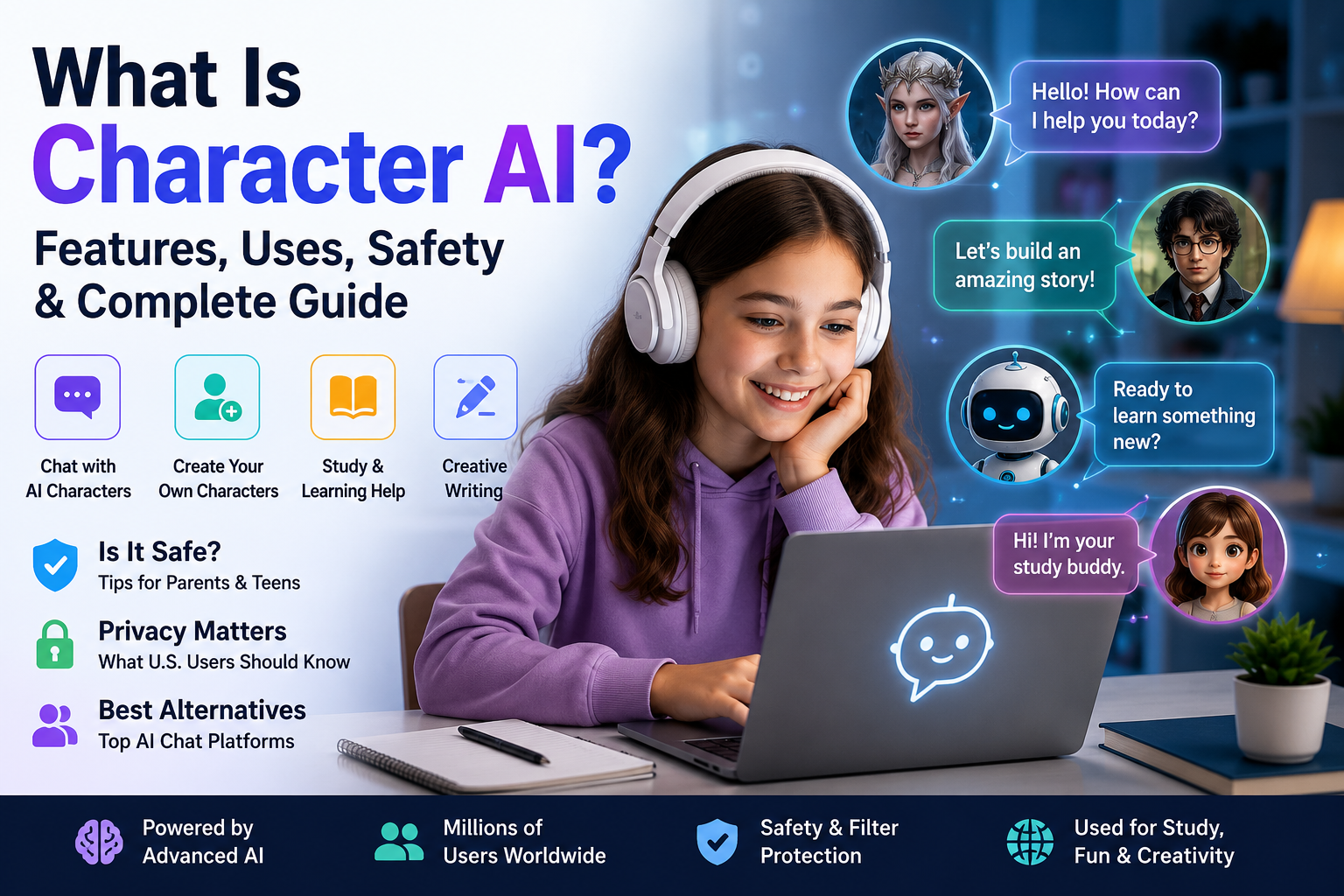
Character AI is an artificial intelligence chatbot platform where users can chat with fictional, historical, educational, entertainment, or user-created AI characters. People use it for roleplay, creative writing, language practice, study help, brainstorming, entertainment, and casual conversations.
For U.S. users, the most important things to understand are how the platform works, what it can and cannot do, how safe it is for teens, what privacy risks may exist, and how to use AI characters responsibly. Character AI can be fun and useful, but users should remember that AI characters are not real people, they can make mistakes, and they should not replace professional advice, real relationships, or trusted support systems.
What Is Character AI?
Character AI official platform is an AI-powered chatbot platform that lets users interact with virtual characters. These characters can be designed to act like fictional personalities, learning assistants, story characters, historical figures, game-style companions, or custom personalities created by users.
The main idea is simple: instead of chatting with a general AI assistant, users chat with a specific character that has a personality, tone, background, and conversation style. For example, someone may chat with a study coach, a fantasy character, a language partner, a writing assistant, or a fictional friend.
This makes Character AI different from regular chatbot tools. It focuses more on conversation, roleplay, creativity, and personality-based interaction.
Why Character AI Became Popular
Character AI became popular because it gives users a more personal and interactive chatbot experience. Many AI tools answer questions in a direct way, but Character AI makes conversations feel more like talking to a specific personality.
Users like it because they can choose from many characters or create their own. This gives the platform a creative and entertainment-based feel. Instead of only asking for facts, users can build scenes, write stories, practice dialogue, explore ideas, or have fun conversations if you need more info for AI news please click link and read more information.
In the U.S., many people are interested in AI tools for productivity, entertainment, education, and creativity. Character AI fits into this trend because it combines chatbot technology with storytelling and personalization.
How Does Character AI Work?
Character AI uses artificial intelligence to generate responses based on what the user types. When a user sends a message, the AI reads the prompt and responds in a way that matches the selected character’s style.
The response depends on several things:
| Factor | How It Affects the Chat |
|---|---|
| Character description | Defines the personality and behavior |
| User message | Guides the current response |
| Conversation context | Helps the AI continue the chat |
| Safety filters | Limit unsafe or inappropriate outputs |
| Platform rules | Control what content is allowed |
| AI model behavior | Affects quality, memory, and response style |
The AI does not truly understand emotions like a human. It predicts and generates text based on patterns. This is why responses can sometimes feel realistic, but users should still treat them as AI-generated.
Main Features of Character AI
Character AI includes several features that make it useful for different types of users.
1. Chat With AI Characters
Users can chat with available AI characters created by the platform or community. These characters may be designed for fun, learning, storytelling, or casual conversation.
2. Create Custom Characters
Users can create their own characters by writing descriptions, personality traits, greetings, and behavior instructions. This is useful for writers, roleplayers, educators, and creative users.
3. Roleplay Conversations
Roleplay is one of the most popular uses. Users can create scenes, continue stories, build fantasy worlds, or interact with characters in a fictional setting.
4. Writing and Brainstorming
Writers can use Character AI to test dialogue, develop characters, explore plot ideas, and practice storytelling.
5. Language Practice
Some users chat with AI characters to practice English, Spanish, French, or other languages. A character can act like a conversation partner.
6. Voice and Personalization Features
Depending on availability and account type, some features may include voice-based interactions, customization, and enhanced chat experiences.
Who Uses Character AI?
Character AI attracts many types of users. Some use it for entertainment, while others use it for learning and creativity.
Common users include:
- Students
- Writers
- Roleplay fans
- Gamers
- Language learners
- Content creators
- AI enthusiasts
- Teens and young adults
- People exploring chatbot technology
- Users interested in fictional conversations
For U.S. audiences, the platform is especially relevant because AI chatbots are becoming part of everyday digital life. Many people are now asking whether these tools are useful, safe, private, and appropriate for younger users.
Character AI for Creative Writing
One of the best uses of Character AI is creative writing. Writers can use it to test character dialogue, generate scene ideas, explore fictional personalities, and overcome writer’s block.
For example, a writer working on a mystery story can create a detective character and test how that character might speak. A fantasy writer can create a wizard, warrior, or village guide. A screenwriter can practice dialogue between two different personalities.
However, writers should not copy AI output blindly. The best approach is to use Character AI as a brainstorming partner, then rewrite and improve the content with human creativity.
Character AI for Students
AI little girl Students may use Character AI for study support, language practice, explanations, and idea generation. For example, a student can chat with a character that acts like a history tutor or vocabulary coach.
It can help students:
- Understand difficult topics
- Practice conversations
- Generate essay ideas
- Review concepts
- Build study routines
- Improve writing practice
- Learn through interactive dialogue
However, students should use it responsibly. AI can make mistakes, so important facts should be checked with trusted sources. Students should also avoid using AI to complete assignments dishonestly.
Character AI for Entertainment
Entertainment is a major reason people use Character AI. Users can chat with fictional characters, create imaginary scenes, play text-based adventures, or build story worlds.
This makes the platform feel different from a normal search engine or productivity tool. It is more interactive and personal. People may use it when they want a creative break, a roleplay experience, or a fun conversation.
Still, users should remember that AI characters are fictional. Even if a chatbot feels emotional or realistic, it is not a real person and should not be treated as one.
Character AI for Language Practice
Character AI can be helpful for language learners because it allows conversation practice without pressure. A user can chat with a character in English, Spanish, French, or another language and practice grammar, vocabulary, and natural phrases.
For example, someone learning English in the U.S. can create a friendly conversation partner who corrects simple mistakes and explains phrases. A student learning Spanish can ask a character to hold a basic conversation at a beginner level.
Language learners should still use teachers, courses, dictionaries, and real speaking practice, but Character AI can be a useful extra tool.
How to Create a Character
Creating a good AI character requires more than just giving it a name. A strong character needs a clear purpose, personality, tone, and behavior.
A basic character setup may include:
- Character name
- Short description
- Personality traits
- Speaking style
- Background story
- Conversation goal
- Example greeting
- Rules for how the character should respond
For example, if someone wants to create a study coach, the character should be helpful, patient, clear, and encouraging. If someone wants to create a fantasy guide, the character should speak in a story-like tone and understand the fictional world.
Tips for Better Character Prompts
A better character prompt creates better conversations. Users should be specific and clear when building a character.
Good prompt example:
“Create a friendly study coach who helps high school students understand science topics in simple language. The coach should explain answers step by step, ask helpful questions, and avoid giving final homework answers without teaching the concept.”
This is better than:
“Make a smart teacher.”
Specific prompts help the AI understand the character’s role and response style.
Is Character AI Free?
Character AI can be used with free access, but some advanced features may be available through paid plans depending on the platform’s current subscription options. Free users can usually chat with characters, explore available bots, and create conversations.
Paid features may include better speed, enhanced memory, additional customization, or early access to selected features. Since subscription features can change, users should check the official pricing page before buying.
For most beginners, the free version is enough to understand how the platform works.
Is Character AI Safe?
Character AI Safety Center can be safe when used carefully, but it also has risks. Like any AI chatbot platform, it can produce incorrect information, emotionally intense conversations, or responses that may not be suitable for every user.
Safety depends on:
- User age
- Type of characters used
- Conversation topics
- Platform safety filters
- Parental guidance
- User expectations
- Privacy awareness
Adults should use AI chatbots with realistic expectations. Teens should have guidance, especially if they use AI characters for emotional conversations, personal problems, or sensitive topics.
Character AI and Teen Safety
AI companion safety guide for Teen is one of the biggest concerns around AI companion and character chatbot platforms. AI characters can feel personal, supportive, or emotionally engaging. This can be positive in creative settings, but it can also become risky if a teen starts depending too much on chatbot conversations.
Parents in the U.S. should understand how their children use AI platforms. They should talk openly about AI, online safety, privacy, and emotional boundaries.
Important parent tips:
- Explain that AI characters are not real people
- Encourage breaks from long chat sessions
- Discuss privacy and personal information
- Review platform settings when available
- Watch for emotional overdependence
- Encourage real-life support from family, teachers, and friends
- Make sure teens know where to get help in serious situations
AI tools should never replace real support from trusted adults or professionals.
Privacy Concerns Users Should Know
Privacy is important when using any AI chatbot. Users should avoid sharing sensitive personal details such as full name, home address, school name, phone number, financial information, passwords, health details, or private family matters.
Even if a chatbot feels friendly, users should remember that they are using an online platform. Conversations may be processed according to the platform’s privacy policies and technical systems for children’s online privacy rule.
Safe privacy habits include:
- Do not share private personal information
- Avoid uploading sensitive content
- Use a separate username
- Review privacy settings
- Read platform policies
- Be careful with emotional or personal conversations
This is especially important for younger users.
Can Character AI Give Wrong Answers?
Yes. Character AI can give wrong, outdated, incomplete, or fictional answers. Since many characters are designed for personality-based conversation, they may not always focus on factual accuracy.
This is important for students, researchers, and anyone asking serious questions. If the topic involves health, law, finance, safety, education, or important decisions, users should verify information from trusted sources.
Character AI is better for conversation, creativity, and brainstorming than for high-stakes factual advice.
Character AI vs Regular Chatbots
Character AI is different from regular AI assistants because it focuses more on personality and conversation style.
| Feature | Character AI | Regular AI Assistant |
| Main purpose | Character-based chat | Task help and answers |
| Best for | Roleplay, stories, fun chats | Research, writing, productivity |
| Personality | Strong character style | Usually neutral |
| Accuracy focus | Varies by character | Often more direct |
| Creative use | Very strong | Strong but less character-focused |
| Study use | Good for practice | Better for structured answers |
| Safety needs | Higher for emotional use | Still important |
Both types of tools can be useful, but users should choose based on their goal.
Pros and Cons of Character AI
| Pros | Cons |
| Fun and interactive conversations | Can give inaccurate information |
| Good for storytelling and roleplay | May feel too emotionally engaging |
| Useful for creative writing | Not a replacement for real advice |
| Can help with language practice | Privacy awareness is needed |
| Allows custom character creation | Some features may require paid access |
| Easy for beginners to use | Quality depends on character design |
This balanced view is important because Character AI is neither all good nor all bad. It is a tool, and its value depends on how it is used.
Best Uses for Character AI
Character AI works best when the goal is creative, educational, or entertainment-based.
Best use cases include:
- Story development
- Roleplay conversations
- Language practice
- Character brainstorming
- Dialogue writing
- Study motivation
- Creative prompts
- Fun fictional chats
- Game-style text adventures
- Practicing interview questions
It is less suitable for professional medical, legal, financial, or emergency advice.
Character AI Alternatives
Some users may want alternatives depending on their needs. A person who wants productivity may prefer a general AI assistant. A writer may prefer tools designed for long-form writing. A student may prefer tutoring platforms. A business user may prefer AI tools built for work.
Possible alternatives include:
- ChatGPT for general help and productivity
- Claude for writing and long-form reasoning
- Gemini for Google-connected AI features
- Replika for AI companion-style chat
- Pi for conversational support
- Janitor AI or other roleplay platforms depending on user preference
- AI writing tools for content creation
- Language learning apps for structured practice
Users should compare features, safety, privacy, pricing, and age rules before choosing any platform.
Should Parents Allow Teens to Use Character AI?
There is no one-size-fits-all answer. Some teens may use Character AI safely for writing, creativity, and language practice. Others may use it in ways that become too personal, distracting, or emotionally unhealthy.
Parents should not only block or allow the platform without understanding it. A better approach is to talk with teens about how they use it and set clear rules.
Possible family rules:
- No sharing personal information
- No late-night excessive use
- No using AI as a replacement for real help
- No private sensitive conversations without trusted support
- Use AI for creativity, learning, and fun
- Take regular breaks
- Talk to a parent or trusted adult if a conversation feels upsetting
Healthy guidance is better than ignoring the tool completely.
How U.S. Users Can Use Character AI Responsibly
Responsible use means understanding what AI can do and where its limits are.
U.S. users should:
- Treat AI characters as fictional
- Verify important information
- Avoid sharing private data
- Use AI for learning and creativity
- Keep emotional boundaries
- Follow platform rules
- Guide younger users
- Avoid harmful or misleading content
- Take breaks from long sessions
- Use trusted sources for serious topics
AI can be useful, but it should support real life, not replace it.
Common Mistakes to Avoid
Many users make simple mistakes when using AI character platforms.
Avoid these mistakes:
- Believing every AI response is true
- Sharing personal details
- Treating AI characters like real people
- Using AI for medical or legal decisions
- Depending on AI for emotional support
- Ignoring safety settings
- Letting teens use it without guidance
- Copying AI content without editing
- Creating harmful or misleading characters
- Spending too much time in roleplay chats
A better experience comes from using the platform with clear limits.
Character AI for Content Creators
Content creators can use Character AI to brainstorm ideas, test dialogue, create fictional scenes, or understand audience questions. For example, a YouTuber may use it to create roleplay scripts. A blogger may use it to generate content angles. A game creator may use it to test character personalities.
However, creators should edit and fact-check everything. AI-generated content should be improved with human experience, originality, and clear purpose.
For SEO content, Character AI should not replace proper research. It can support brainstorming, but final content should be helpful, accurate, and written for real users.
Future of AI Character Chatbots
AI character chatbots are likely to become more advanced. Future versions may have better memory, more realistic voices, improved safety systems, stronger personalization, and better tools for creators.
They may become common in gaming, education, storytelling, entertainment, and virtual learning. Students may practice with AI tutors, writers may build interactive characters, and users may explore custom fictional worlds.
At the same time, safety will become even more important. Platforms will need better age controls, privacy protections, transparency, and responsible design.
The future of Character AI and similar tools will depend on balancing creativity with user safety.
Final Thoughts
Character AI is one of the most popular examples of personality-based AI chat. It allows users to talk with virtual characters, create custom personalities, practice language, develop stories, and explore creative conversations.
For U.S. users, the key is to use it responsibly. It can be helpful for creativity, learning, and entertainment, but users should remember that AI characters are fictional and not always accurate. Parents should guide teens, users should protect privacy, and everyone should verify important information.
When used with the right expectations, Character AI can be a fun and useful tool. When used without limits, it can create confusion, privacy risks, or emotional overdependence. The smartest approach is to enjoy the creative benefits while keeping safety, privacy, and real-world judgment first more info avaliable on DailyViewMag technology updates.
FAQs
1. What is Character AI?
Character AI is an AI chatbot platform where users can chat with virtual characters, create custom personalities, and use AI conversations for entertainment, writing, learning, or roleplay.
2. Is Character AI free?
Character AI can be used for free, but some advanced or premium features may require a paid subscription depending on the platform’s current plans.
3. Is Character AI safe for kids?
It depends on the child’s age, usage, settings, and parental guidance. Parents should review safety features, discuss privacy, and guide teens on healthy AI use.
4. Can Character AI chats be wrong?
Yes. AI characters can generate inaccurate, fictional, or outdated information. Users should verify important facts from trusted sources.
5. Can I create my own character?
Yes, users can create custom AI characters by adding a name, description, personality, greeting, and behavior instructions.
6. What is Character AI used for?
It is commonly used for roleplay, creative writing, language practice, entertainment, study support, brainstorming, and fictional conversations.
7. Is Character AI good for students?
It can help students practice explanations, languages, and study habits, but students should not use it to cheat or replace real learning.
8. Does Character AI replace real people?
No. AI characters are not real people. They can simulate conversation, but they should not replace real relationships, trusted adults, teachers, or professional support.
9. What are the best Character AI alternatives?
Alternatives depend on the purpose. ChatGPT, Claude, Gemini, Replika, Pi, and other AI chatbot platforms may be useful depending on whether the user wants productivity, companionship, writing, or roleplay.
10. Should parents monitor Character AI use?
Yes, parents should understand how teens use AI character apps, discuss privacy and emotional boundaries, and set healthy screen-time and safety rules.