AI Transformation Is a Problem of Governance, Not Just Technology
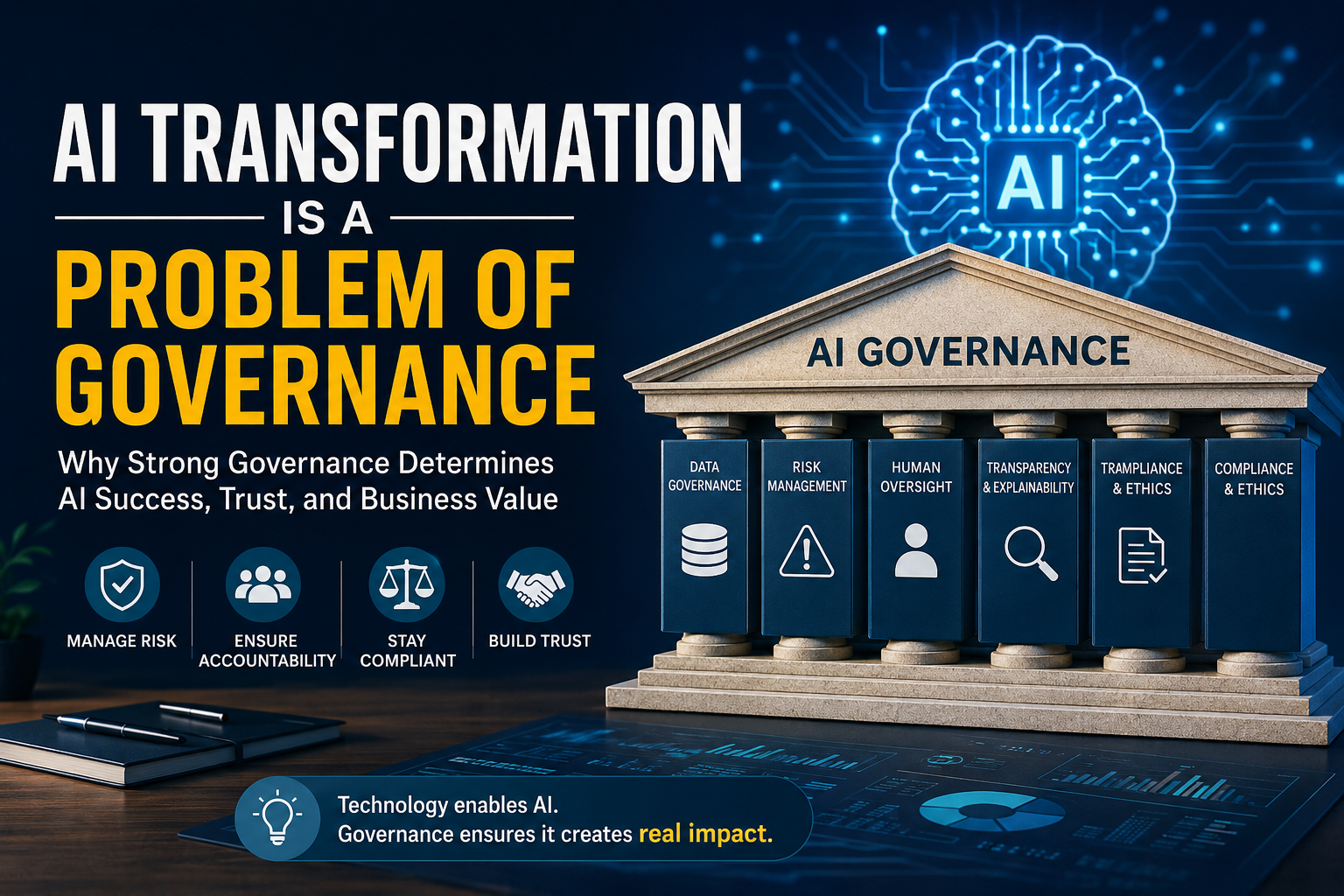
AI transformation is a problem of governance because artificial intelligence does not only change tools; it changes how decisions are made, who controls risk, and who becomes accountable when automated systems influence real business outcomes. Many organizations invest in AI software, automation platforms, machine learning models, and generative AI tools, yet still struggle to turn experiments into measurable value.
The reason is simple. AI transformation requires more than technical adoption. It requires leadership alignment, clear decision rights, responsible AI policies, data governance, human oversight, risk controls, and continuous monitoring. Without these foundations, AI becomes another scattered technology project instead of a trusted operating capability.
Quick Answer: Why Is AI Transformation a Governance Problem?
AI transformation becomes a governance problem when organizations deploy AI without a clear structure for ownership, accountability, risk management, compliance, and performance monitoring. The technology may work, but the organization may not be ready to control how it is used.
Strong AI governance defines which AI use cases are allowed, who approves them, how data is protected, how models are tested, and what happens when an AI system produces biased, inaccurate, unsafe, or legally risky outputs.
This is why enterprise AI governance is now a core part of digital transformation. The NIST AI Risk Management Framework was created to help organizations improve trustworthiness across the design, development, use, and evaluation of AI systems.
AI Adoption vs. AI Transformation vs. AI Governance
AI adoption means using AI tools in daily work. This may include chatbots, AI writing assistants, automated reporting, predictive analytics, or customer support automation.
AI transformation goes deeper. It changes business processes, workflows, customer experiences, employee roles, and decision-making systems. It is not just about using AI faster. It is about redesigning how work gets done.
AI governance is the system that keeps this transformation controlled, ethical, secure, and aligned with business goals. It includes policies, roles, standards, approval workflows, audit trails, compliance checks, vendor reviews, model monitoring, and escalation processes.
Without governance, AI adoption may still happen, but transformation becomes fragmented. Teams may use different tools, follow different standards, expose sensitive data, or make decisions without proper review.
Why AI Projects Fail Without Governance
Many AI projects fail because organizations focus on model performance while ignoring operational control. A tool may perform well in a pilot, but that does not mean it is ready for production use across departments.
The common governance gaps include unclear ownership, poor data quality, weak security checks, limited human review, inconsistent vendor evaluation, and no system for monitoring AI outputs over time.
For example, an AI model used in hiring, lending, healthcare, pricing, insurance, or customer support can affect people directly. If the organization cannot explain how the system works, where the data came from, who approved it, and how errors are handled, the risk becomes larger than the benefit.
This is where AI transformation is a problem of governance. The challenge is not simply whether AI can produce an answer. The challenge is whether the organization can trust, control, explain, and improve that answer at scale.
The Core Pillars of an AI Governance Framework
A practical AI governance framework should be simple enough to follow but strong enough to protect the business. The most effective frameworks usually include the following pillars.
| Governance Pillar | What It Controls | Why It Matters |
|---|---|---|
| AI Ownership | Who approves, manages, and reviews AI systems | Prevents confusion and shared-responsibility gaps |
| Data Governance | Data quality, privacy, consent, and lineage | Reduces bias, privacy risk, and unreliable outputs |
| Risk Classification | Low, medium, and high-risk AI use cases | Helps teams apply the right level of control |
| Human Oversight | When humans must review AI decisions | Protects customers and reduces harmful automation |
| Model Monitoring | Accuracy, drift, bias, and performance | Keeps AI reliable after deployment |
| Vendor Governance | Third-party AI tools and contracts | Reduces security, compliance, and data exposure risks |
| Audit and Documentation | Records, approvals, tests, and decisions | Supports compliance, trust, and accountability |
Businesses can also follow the NIST AI Risk Management Framework to better manage AI risks, improve accountability, and build trustworthy AI systems
These pillars turn AI governance from a policy document into a working operating model.
Why Data Governance Is the Foundation of AI Governance
AI systems depend on data. If the data is incomplete, outdated, biased, duplicated, or poorly classified, the AI output will also become unreliable.
This makes data governance one of the most important parts of AI transformation. Organizations need to know where their data comes from, who owns it, how it is stored, what can be used for AI training or prompting, and which information must remain restricted.
IBM describes data and AI governance as connected parts of enterprise governance, especially because AI decisions depend on data lineage and verified inputs.
Poor data governance can lead to inaccurate recommendations, unfair decisions, compliance violations, and customer trust issues. Strong data governance gives AI systems a cleaner, safer, and more explainable foundation.
AI Governance and Regulatory Pressure in 2026
In 2026, AI governance is no longer just an internal best practice. It is becoming a regulatory and reputational requirement.
The EU AI Act entered into force on August 1, 2024, and is scheduled to become fully applicable on August 2, 2026, with some exceptions depending on the type of AI system. This matters even for companies outside Europe if they sell into EU markets or use AI systems that affect EU users.
The OECD AI Principles also promote trustworthy AI that respects human rights and democratic values. These principles were adopted in 2019 and updated in 2024, showing that AI governance expectations are becoming more mature globally.
This does not mean every business needs a large compliance department. It does mean every serious AI program needs documented policies, risk classification, approval processes, monitoring, and accountability.
Board-Level AI Oversight Is Now Essential
AI transformation cannot be left only to IT teams or data science teams. Since AI can affect revenue, reputation, compliance, privacy, customer experience, and workforce design, governance must include executive leadership.
Board-level AI oversight helps organizations answer critical questions:
Who owns AI risk across the company?
Which AI use cases are approved for production?
Which systems require human review?
How are vendors assessed before adoption?
How are AI mistakes reported and corrected?
How does the company prove responsible AI use?
IBM’s enterprise AI governance guidance also emphasizes senior-level leadership because fragmented ownership and unclear accountability increase the risk of failure.
When leadership treats AI governance as a strategic priority, teams can innovate faster because the rules are clearer.
Human Oversight Protects Trust
One of the biggest mistakes in AI transformation is assuming that automation should replace human judgment everywhere. In reality, high-impact AI systems often need human oversight.
Human review is especially important when AI affects employment, financial decisions, medical support, legal processes, customer complaints, fraud detection, safety, or public-facing communication.
Human oversight does not slow transformation. It makes transformation safer. It gives organizations a way to catch errors, review edge cases, manage exceptions, and protect users from harmful automated decisions.
The goal is not to block AI. The goal is to define where AI can act independently, where it can assist, and where humans must remain responsible.
How Organizations Can Build Practical AI Governance
A strong AI governance model does not need to begin with a complicated framework. It can start with a practical operating structure.
First, organizations should create an AI inventory. This includes internal tools, third-party AI platforms, chatbots, automation systems, predictive models, and employee-used AI applications.
Second, each AI use case should be classified by risk. A content idea generator is low risk. An AI system that influences hiring, lending, insurance, healthcare, or legal decisions is much higher risk.
Third, companies should assign ownership. Every AI system should have a business owner, technical owner, data owner, and risk or compliance reviewer.
Fourth, teams should document how the AI system works. This includes purpose, data sources, limitations, testing results, vendor details, security controls, and review process.
Fifth, organizations should monitor AI after launch. AI systems can drift, become less accurate, produce biased outputs, or fail when business conditions change.
This continuous governance approach helps companies move from random AI experiments to scalable AI transformation.
The Business Value of Governed AI Transformation
Good governance does not reduce innovation. It increases the chances that innovation becomes sustainable.
When AI governance is strong, organizations can approve use cases faster, reduce tool sprawl, protect sensitive data, improve compliance readiness, and build trust with customers, employees, and partners.
Governed AI transformation also improves decision quality. Teams know which data to use, which tools are approved, which outputs need review, and how to escalate risks. This creates a more reliable environment for automation and decision support.
In competitive markets, governance can become a business advantage. Companies that manage AI responsibly can scale faster because they are not constantly reacting to risks, mistakes, or unclear ownership.
Common AI Governance Mistakes to Avoid
Organizations often make AI governance harder by treating it as a one-time policy project. A document alone cannot govern AI. Governance must be embedded into daily workflows, procurement, product development, employee training, and risk review.
Another common mistake is giving AI ownership to one department only. IT can manage infrastructure, but it cannot own legal risk, customer impact, ethics, business value, and operational change alone.
Companies also fail when they ignore shadow AI. Employees may use unapproved AI tools because official processes are too slow. Instead of only blocking these tools, leaders should create approved alternatives, clear usage rules, and practical training.
The final mistake is measuring AI success only by productivity. AI should also be measured by accuracy, reliability, user trust, risk reduction, compliance readiness, and business outcomes.
The Business Advantage of Governed AI Transformation
AI transformation is a problem of governance because AI changes authority, accountability, and risk across the business. The companies that succeed will not be the ones that simply buy the most advanced tools. They will be the ones that build the clearest rules for using those tools responsibly.
A strong AI governance framework gives organizations the structure to move from experiments to real transformation. It connects AI strategy with leadership oversight, data governance, risk management, human review, compliance, and continuous monitoring.
In 2026 and beyond, responsible AI will not be optional for serious organizations. It will be a requirement for trust, scale, and long-term value. AI can improve how businesses operate, but governance decides whether that improvement becomes sustainable success or unmanaged risk.
FAQs
What does “AI transformation is a problem of governance” mean?
It means AI transformation fails when organizations lack clear ownership, policies, oversight, risk controls, and accountability. The issue is not only the AI tool. The bigger issue is how the organization manages and controls AI use.
Why is AI governance important for business transformation?
AI governance is important because it helps businesses use AI safely, ethically, and effectively. It protects data, improves accountability, supports compliance, and helps AI systems scale beyond small experiments.
What should an AI governance framework include?
An AI governance framework should include AI ownership, data governance, risk classification, human oversight, vendor review, model monitoring, documentation, compliance checks, and escalation processes.
Who should be responsible for AI governance?
AI governance should be shared across executive leadership, legal, compliance, security, data, product, operations, and business teams. However, there should also be a clear owner or committee with real decision-making authority.
How does poor governance affect AI transformation?
Poor governance creates tool sprawl, security risks, biased outputs, unclear accountability, weak compliance, and failed pilots. It prevents AI from becoming a trusted part of daily business operations.
Is AI governance only for large enterprises?
No. Small and mid-size businesses also need AI governance. Their framework can be simpler, but they still need clear rules for approved tools, sensitive data, human review, vendor selection, and risk management.