Agentic AI vs Generative AI: 7 Powerful Key Differences Explained
Agentic AI vs generative AI is one of the most important AI comparisons for anyone trying to understand where artificial intelligence is heading. The simple difference is this: generative AI creates content when a user gives a prompt, while agentic AI can plan, make decisions, and take actions to complete a goal. Generative AI is helpful for writing, images, code, summaries, and ideas. Agentic AI goes a step further by using tools, memory, data, and workflows to act more like a digital assistant that can complete multi-step tasks with less human guidance.
Both technologies are connected, but they are not the same. Generative AI is often the engine behind many AI tools, while agentic AI uses that engine to move from “answering” to “doing.” IBM explains that agentic AI and generative AI are different technologies because generative AI focuses on creating content, while agentic AI focuses more on decisions and actions. IBM describes agentic AI as more proactive, while generative AI is usually reactive to user input. Google Cloud also explains that both can work together, but they have different functions. Understanding agentic AI vs generative AI helps users choose the right AI tools for writing, automation, research, customer support, and business workflows.
What Is Generative AI?
Generative AI is a type of artificial intelligence that creates new content from a user’s prompt. This content can include text, images, videos, audio, code, summaries, emails, reports, product descriptions, and more.
For example, when someone asks an AI tool to “write a blog introduction about cybersecurity,” the system generates a written response. When a designer asks an AI image tool to create a product mockup, it generates a visual output. This is generative AI in action.
Generative AI is mostly prompt-based. The user gives an instruction, and the AI responds with an output. It can be powerful, but it usually depends on the human to guide the next step.
Common examples of generative AI
Generative AI is used for:
- Blog writing and content creation
- Image generation
- Video scripts
- Email writing
- Resume writing
- Coding help
- Data summaries
- Marketing copy
- Customer support replies
- Research summaries
The main value of generative AI is speed. It helps people create, edit, summarize, and brainstorm faster.
What Is Agentic AI?
Agentic AI is artificial intelligence that can work toward a goal by planning steps, using tools, making decisions, and taking action. Instead of only responding to one prompt, agentic AI can complete a process.
AWS explains that an AI agent can interact with its environment, collect data, and perform self-directed tasks to meet a goal set by humans. In simple words, the human gives the goal, and the AI figures out the steps needed to complete it.
For example, instead of asking AI to “write an email,” a user could ask an agentic AI system to “find the best leads, check their websites, draft personalized emails, and schedule follow-ups.” That is a more advanced workflow because the AI is not only generating text; it is performing actions.
Common examples of agentic AI
Agentic AI can be used for:
- Customer support automation
- Sales follow-up workflows
- Data research and reporting
- Appointment scheduling
- Code testing and debugging
- Business process automation
- Cybersecurity monitoring
- Travel planning
- CRM updates
- AI personal assistants
Agentic AI is more action-focused. It does not just create content; it can help complete tasks.
Agentic AI vs Generative AI: Main Difference
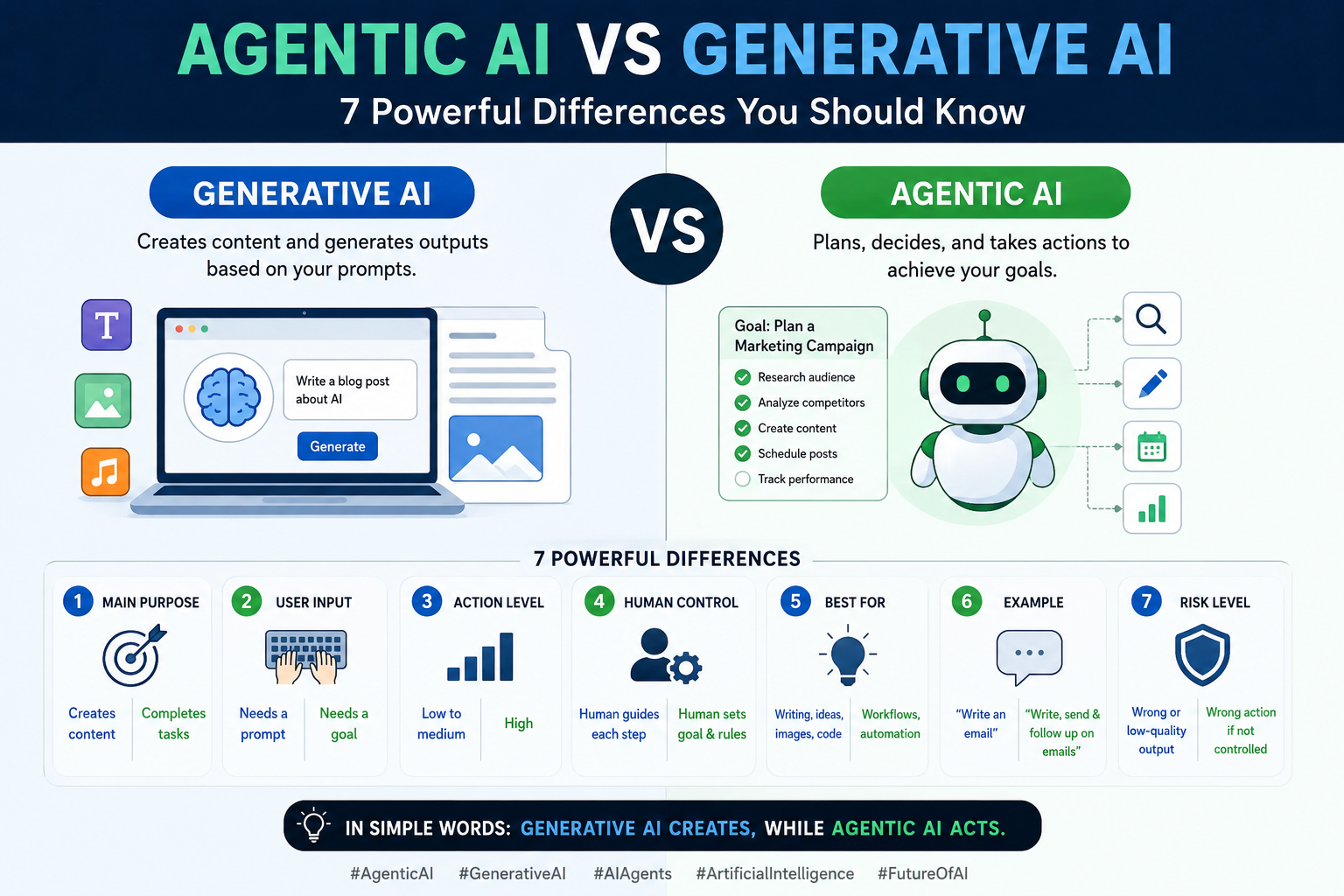
The main difference between agentic AI and generative AI is execution. Generative AI creates an output. Agentic AI works toward a goal.
AWS summarizes it clearly: generative AI creates content for a person to review, while agentic AI takes policy-bounded actions to complete tasks. The easiest way to compare agentic AI vs generative AI is to look at what each system does after the user gives an instruction.
Here is a simple comparison:
| Feature | Generative AI | Agentic AI |
|---|---|---|
| Main purpose | Creates content | Completes tasks |
| User input | Needs a prompt | Needs a goal |
| Action level | Low to medium | High |
| Human control | Human guides each step | Human sets goal and rules |
| Best for | Writing, images, ideas, code | Workflows, automation, decisions |
| Example | “Write an email” | “Write, send, and follow up on emails” |
| Risk | Wrong or low-quality output | Wrong action if not controlled |
| Business value | Saves time on content | Saves time on operations |
Agentic AI vs Generative AI for Beginners
For beginners, agentic AI vs generative AI can be understood with a simple example. Generative AI is like a smart content creator. It can write an article, create an image, summarize a document, or suggest ideas. Agentic AI is more like a smart task manager. It can understand a goal, break it into steps, use tools, and complete a workflow.
This is why agentic AI vs generative AI is not only about technology terms. It is about how AI is being used in real life. One type of AI helps people create faster, while the other helps people get work done faster.
A simple way to remember it is:
- Generative AI answers and creates.
- Agentic AI plans and acts.
- Generative AI needs more step-by-step human input.
- Agentic AI can continue a task with less human direction.
- Generative AI is best for content.
- Agentic AI is best for workflows.
For example, if a user asks AI to “write a product description,” that is generative AI. But if a user asks AI to “check product data, write the description, upload it to a store, and create a report,” that becomes closer to agentic AI.
This beginner-level difference makes agentic AI vs generative AI easier to understand for students, business owners, marketers, developers, and anyone learning about modern artificial intelligence.
Why Agentic AI vs Generative AI Matters in 2026
Agentic AI vs generative AI matters more in 2026 because businesses are no longer using AI only for writing or brainstorming. Many companies now want AI systems that can support operations, customer service, sales, research, coding, and automation.
Generative AI became popular because it made content creation faster. It helped people write emails, blogs, captions, summaries, scripts, and code. But as users became more comfortable with AI, they started asking for more than simple answers. They wanted AI to complete tasks.
This is where agentic AI becomes important. Agentic AI can connect with software tools, analyze information, follow instructions, and complete multi-step processes. That makes it useful for companies that want to save time on repeated work.
For example, a marketing team may use generative AI to write ad copy. But the same team may use agentic AI to research competitors, create campaign ideas, prepare reports, schedule content, and track performance. This shows why agentic AI vs generative AI is becoming a major topic in business technology.
The future of AI will likely include both. Generative AI will remain useful for content and creativity. Agentic AI will become more important for automation and decision support.
Agentic AI vs Generative AI in Daily Life
Agentic AI vs generative AI is also easy to understand through daily life examples. Most people already use generative AI when they ask a chatbot to write something, explain a topic, or create an idea. It is useful because it gives quick output.
For example, a student may use generative AI to summarize a chapter. A job seeker may use it to improve a resume. A blogger may use it to create an outline. A designer may use it to generate image ideas. In all these cases, the AI is creating something based on a prompt.
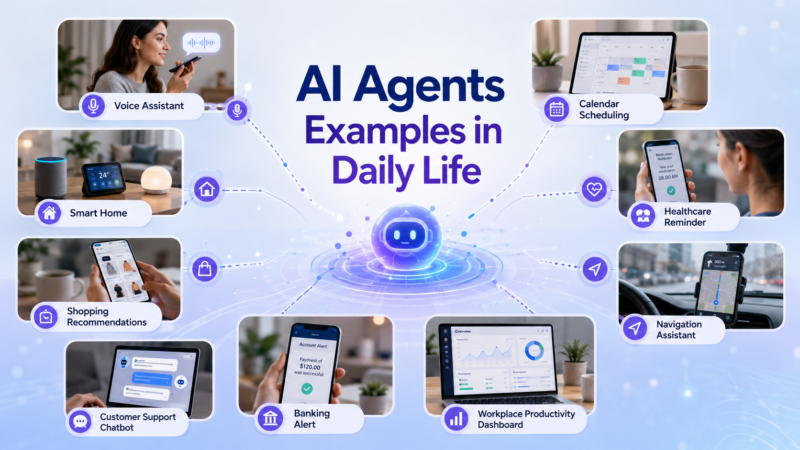
Agentic AI is different because it can handle a process. Imagine a user wants to plan a trip. Generative AI can suggest places to visit. Agentic AI can compare flights, check hotel options, create an itinerary, organize the schedule, and remind the user about booking steps.
Another example is email management. Generative AI can write a reply. Agentic AI can read the email, understand the request, check the calendar, draft a response, and schedule a meeting if the user approves.
These examples show that agentic AI vs generative AI is really about the difference between creating an answer and completing a task.
When Should You Use Generative AI?
Generative AI is the better choice when the user needs a quick creative or informational output. It is simple, fast, and easy to control because the user decides what to do with the result.
Generative AI is best for:
- Writing blog posts
- Creating social media captions
- Drafting emails
- Making outlines
- Summarizing reports
- Creating image prompts
- Writing product descriptions
- Explaining difficult topics
- Generating code examples
- Brainstorming ideas
If the task only needs one output, generative AI is usually enough. For example, writing a paragraph, improving grammar, creating a title, or summarizing a document does not always need agentic AI.
This is why generative AI is still important in the agentic AI vs generative AI discussion. Even if agentic AI becomes more advanced, generative AI will continue to be useful for content, communication, and creative work.
When Should You Use Agentic AI?
Agentic AI is better when the task has multiple steps. It is useful when the user wants AI to move through a workflow instead of only creating one answer.
Agentic AI is best for:
- Researching and organizing data
- Managing customer support tasks
- Scheduling meetings
- Updating CRM records
- Creating automated reports
- Monitoring cybersecurity alerts
- Testing and debugging code
- Handling sales follow-ups
- Managing repetitive business workflows
- Connecting different tools together
For example, a business owner may not only want an AI-written email. They may want the AI to check customer history, write the email, add the customer to a follow-up list, and create a reminder. That is where agentic AI becomes more valuable.
This is the practical side of agentic AI vs generative AI. Generative AI helps with the output, while agentic AI helps with the full process.
Quick Summary: Agentic AI vs Generative AI
The simplest summary of agentic AI vs generative AI is this: generative AI is best for creating, while agentic AI is best for acting.
Generative AI can produce text, images, ideas, summaries, and code. It usually waits for a user prompt and gives a response. Agentic AI can understand a goal, plan steps, use tools, and continue working toward completion.
Both are useful, and both can work together. A business may use generative AI to write content and agentic AI to manage the workflow around that content. A developer may use generative AI to write code and agentic AI to test, debug, and document the project.
So, agentic AI vs generative AI should not be seen as a competition where one replaces the other. It is better to understand them as two different levels of AI use. Generative AI creates the output. Agentic AI helps complete the action.
How Generative AI Works
Generative AI works by learning patterns from large amounts of data and then creating new outputs based on the user’s request. It does not “think” like a human, but it predicts what output is most likely to match the prompt.
For example, if a user asks for a product description, generative AI looks at the instruction, understands the context, and produces text that fits the request. The result depends heavily on the quality of the prompt.
A better prompt usually gives a better result. That is why generative AI often needs human review, editing, and direction.
How Agentic AI Works
Agentic AI usually works through a loop: understand the goal, plan the task, use tools, check progress, and take the next action. In many cases, it uses a large language model as its reasoning layer, but it may also connect with tools such as calendars, browsers, CRMs, databases, email platforms, or APIs.
AWS notes that in generative AI systems, agents are often powered by large language models and extended with capabilities like retrieval, tools, and memory. AWS explains that AI agents can perform self-directed tasks after humans define the goal.
A simple agentic AI workflow may look like this:
- The user gives a goal.
- The AI breaks the goal into smaller tasks.
- The AI decides which tools or data it needs.
- The AI performs the task.
- The AI checks the result.
- The AI continues until the goal is completed.
This makes agentic AI more useful for complex work where one answer is not enough.
Real-Life Example: Generative AI vs Agentic AI
Imagine a small business owner wants to improve customer support.
With generative AI, the owner can ask:
“Write a polite reply to a customer asking about a delayed order.”
The AI will generate a response. The owner still has to check the order, confirm details, send the email, and update the customer record.
With agentic AI, the owner can ask:
“Check this customer’s order status, write a reply, update the CRM, and create a follow-up task if the order is still delayed.”
Now the AI is not just writing. It is checking information, using tools, taking action, and managing the workflow.
That is the real difference.
Which One Is Better?
Agentic AI is not always better than generative AI. The better choice depends on the task.
Generative AI is better when the goal is content creation, brainstorming, summarizing, or editing. It is simple, fast, and easy to use.
Agentic AI is better when the goal requires multiple steps, decisions, tools, and actions. It is more powerful for automation, but it also needs stronger rules, permissions, and monitoring.
For most businesses, the best option is not choosing one over the other. The best option is using both. Generative AI can create the content, while agentic AI can manage the workflow around that content.
Benefits of Generative AI
Generative AI is useful because it makes everyday creative and communication tasks faster. It can help users produce drafts, ideas, outlines, summaries, and visual concepts in seconds.
Main benefits include:
- Faster content creation
- Better brainstorming
- Easier research summaries
- Improved productivity
- Lower content production time
- Support for coding and documentation
- Quick personalization for emails and ads
For students, marketers, writers, developers, and small business owners, generative AI is often the easiest starting point in automation tools.
Benefits of Agentic AI
Agentic AI is useful because it can reduce manual work in business processes. Instead of asking AI for one answer at a time, users can give it a goal and allow it to complete several steps.
Main benefits include:
- Better workflow automation
- Less manual follow-up
- Faster decision-making
- Improved customer support
- More efficient research tasks
- Automated reporting
- Better use of business tools
- Scalable operations
Agentic AI is especially valuable in sales, customer service, cybersecurity, software development, and operations.
Risks of Generative AI
Generative AI can still make mistakes. It may produce incorrect facts, outdated information, biased answers, or content that sounds good but lacks accuracy. This is why human review is important.
Common risks include:
- Hallucinated facts
- Generic content
- Copyright concerns
- Poor source quality
- Overdependence on AI writing
- Lack of human experience or originality
For SEO content, generative AI should not be used to publish low-quality articles without editing, fact-checking, and adding real expertise.
Risks of Agentic AI
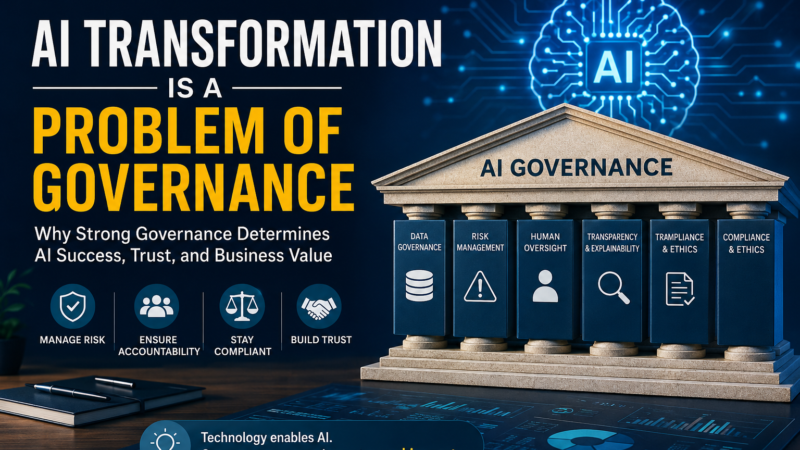
The risk level in agentic AI vs generative AI is also different because agentic AI can take actions, while generative AI usually creates outputs for review. Agentic AI in cybersecurity has bigger risks because it can take actions. If the system has too much access or poor instructions, it may make wrong decisions, send incorrect messages, update the wrong data, or create workflow errors. Because agentic AI can take actions, businesses should follow responsible AI principles for safety, privacy, transparency, and accountability.
Common risks include:
- Wrong action execution
- Data privacy issues
- Security risks
- Poor decision-making
- Lack of human oversight
- Tool misuse
- Automation mistakes
That is why agentic AI should have clear permissions, human approval for sensitive actions, audit logs, and strong security controls.
Agentic AI and Generative AI in Business
Businesses are moving from simple AI chat tools toward AI systems that can support real operations. Generative AI helps teams create faster. Agentic AI helps teams execute faster. For businesses, agentic AI vs generative AI matters because one improves content creation while the other improves task execution.
For example:
- Marketing teams can use generative AI to create campaign ideas.
- Sales teams can use agentic AI to research leads and schedule follow-ups.
- Customer support teams can use generative AI to draft replies.
- Support teams can use agentic AI to check accounts and resolve tickets.
- Developers can use generative AI to write code snippets.
- Engineering teams can use agentic AI to test, debug, and document workflows.
In short, generative AI improves output creation, while agentic AI improves task completion.
Future of Agentic AI vs Generative AI
The future of agentic AI vs generative AI will likely involve both technologies working together inside smarter business tools. Generative AI will continue to improve content creation, while agentic AI will become more common in workplace automation.
As AI tools become more connected with business software, users will expect AI to do more than answer questions. They will expect AI to complete tasks, manage workflows, and support decisions.
However, this does not mean humans will become unnecessary. Human judgment will still matter for strategy, creativity, ethics, approvals, and quality control. The strongest AI systems will likely be those that combine automation with human oversight.
Conclusion
Agentic AI vs generative AI is not only a technical comparison. It shows how artificial intelligence is moving from content creation to task execution. Generative AI is best for creating text, images, code, ideas, and summaries. Agentic AI is best for planning, decision-making, tool use, and completing multi-step workflows.
The easiest way to remember the difference is simple: generative AI creates, while agentic AI acts. For most users and businesses, both will be useful. Generative AI can help produce better content faster, and agentic AI can help complete work with less manual effort. In simple words, agentic AI vs generative AI comes down to creation versus action.
As AI continues to evolve, understanding the difference between agentic AI and generative AI will help users choose the right tools, build better workflows, and use artificial intelligence more safely and effectively.
FAQs
What is agentic AI vs generative AI?
The main difference is that generative AI creates content from prompts, while agentic AI can plan and take actions to complete a goal. Generative AI answers or creates. Agentic AI acts and executes tasks.
Is agentic AI the same as generative AI?
No, agentic AI and generative AI are not the same. Generative AI focuses on creating outputs such as text, images, or code. Agentic AI can use generative AI, but it also adds planning, decision-making, tool use, and task execution.
Can agentic AI use generative AI?
Yes, many agentic AI systems use generative AI as the reasoning or language layer. The generative AI model helps understand instructions and create responses, while the agentic system uses tools and workflows to take action.
Which is better for business: agentic AI vs generative AI?
Both can help businesses. Generative AI is better for content, writing, ideas, and summaries. Agentic AI is better for automation, customer support, sales workflows, reporting, and multi-step tasks.
What is an example of generative AI?
An example of generative AI is a tool that writes a blog post, creates an image, summarizes a report, writes code, or drafts an email based on a user’s prompt.
What is an example of agentic AI?
An example of agentic AI is a system that checks customer data, writes a response, updates a CRM, schedules a follow-up, and reports the result to a human user.
Is agentic AI safe?
Agentic AI can be safe if it has clear limits, permissions, security controls, human approval, and audit logs. Because it can take actions, it needs more careful monitoring than basic generative AI tools.
Will agentic AI replace generative AI?
No, agentic AI will not fully replace generative AI. Instead, both will likely work together. Generative AI creates content, while agentic AI uses that ability inside larger workflows.