Et Al Meaning: How to Use It Correctly
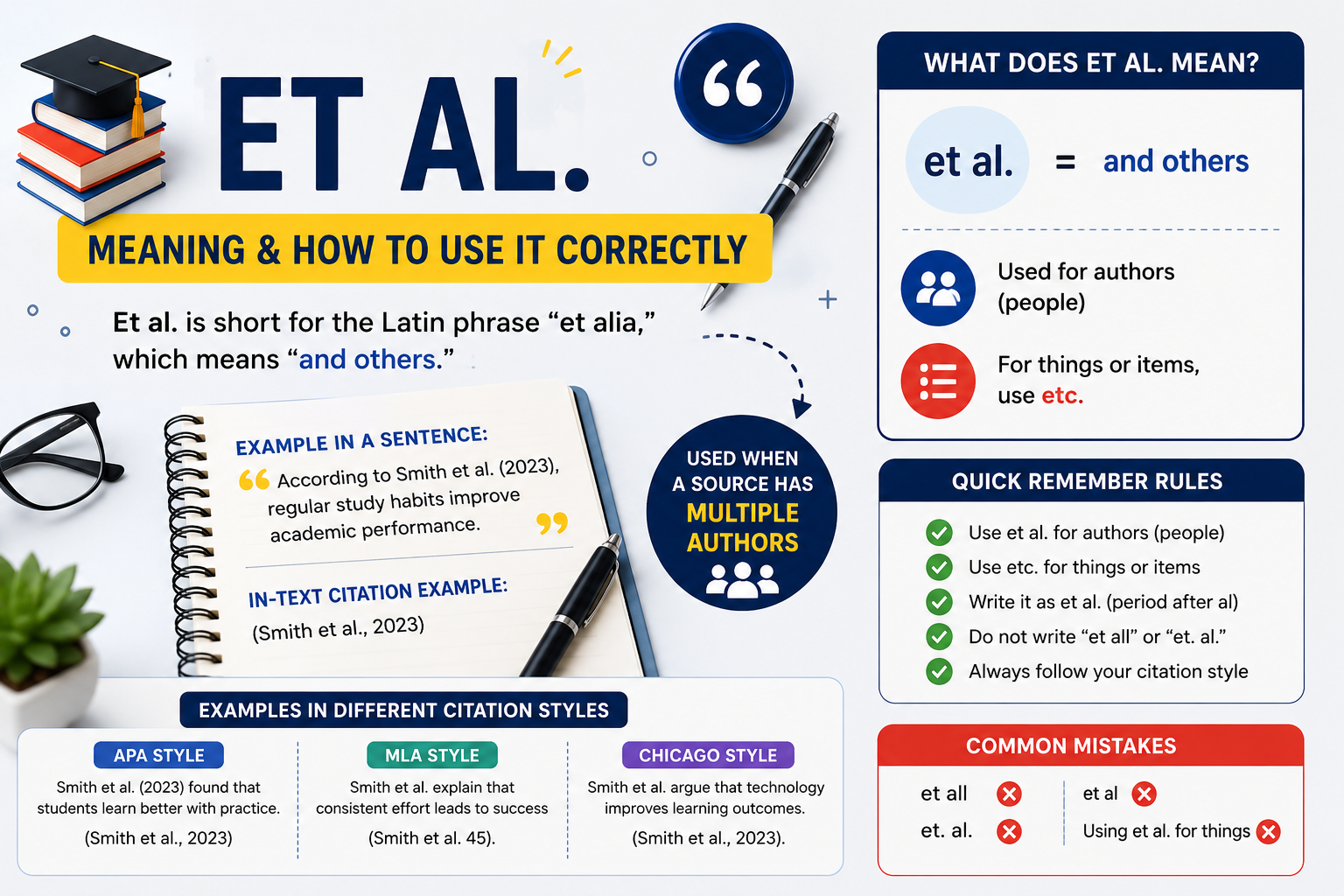
The term et al is commonly used in academic writing, research papers, citations, essays, books, and scholarly articles. Many students and beginner writers see this phrase in references but do not fully understand what it means or how to use it correctly. The phrase may look small, but using it properly is important because it helps make citations shorter, cleaner, and more professional.
In simple words, et al means “and others.” It is used when a source has multiple authors, and the writer does not want to list every author’s name again and again in the text. Instead of writing all author names, you write the first author’s name followed by “et al.”
For example, instead of writing “Smith, Johnson, Brown, and Miller,” you may write “Smith et al.” depending on the citation style you are using.
This guide explains what et al means, where it comes from, how to use it in citations, when not to use it, and the common mistakes students should avoid.
What Does Et Al Mean?
Et al is a shortened form of the Latin phrase et alia, which means “and others.” It is mostly used in academic citations when a work has more than one author.
The word “et” means “and,” while “al.” is an abbreviation for “alia,” meaning “others.” Since “al.” is an abbreviation, it usually has a period after it.
Correct form:
et al.
Incorrect forms:
et. al
et. al.
etal
et all
The correct academic form is et al. with a period after “al” only.
Why Do Writers Use Et Al?
Writers use et al to keep citations short and readable. Academic writing often includes many sources, and some research papers may have three, five, ten, or even more authors. Listing all author names every time can make the sentence long and difficult to read.
For example:
Long version:
Smith, Johnson, Brown, Miller, and Davis found that student motivation improved with active learning.
Short version:
Smith et al. found that student motivation improved with active learning.
The second sentence is cleaner and easier to read. This is why et al is useful in research writing.
How to Pronounce Et Al
Et al is usually pronounced as:
et al
Some people say it like “et all,” but in writing, it should not be spelled that way. The correct written form remains et al.
It is a Latin abbreviation, so the spelling and punctuation matter in academic writing.
When Should You Use Et Al?
You should use et al when a source has multiple authors and your citation style allows it. The exact rule depends on the style guide you are following, such as APA, MLA, Chicago, Harvard, or another academic format.
In many citation styles, et al is used when there are three or more authors. However, rules can vary, so students should always check the required citation style given by their teacher, university, journal, or publisher.
Common places where et al appears include:
- In-text citations
- Research paper references
- Academic essays
- Literature reviews
- Journal articles
- Books with multiple authors
- Conference papers
- Thesis and dissertation writing
Et Al in a Sentence
Et al is usually placed after the first author’s last name.
Examples:
Smith et al. argue that digital learning improves student engagement.
According to Johnson et al., online tools can support classroom learning.
Recent research by Ahmed et al. shows the importance of cybersecurity awareness.
In these examples, et al tells the reader that the work has more authors, but only the first author is named in the sentence.
Et Al in Parentheses
Et al is also commonly used inside parentheses for in-text citations.
Examples:
Digital learning can improve student engagement when used properly (Smith et al., 2023).
Cybersecurity awareness is important for students and businesses (Ahmed et al., 2024).
Online tools can support productivity and collaboration (Johnson et al., 2022).
This format is common in academic writing, but the exact punctuation may depend on the citation style.
Et Al in APA Style
In APA style, et al is commonly used for in-text citations when a source has three or more authors. The first author’s last name is written, followed by et al. and the year APA author-date citation rules.
Example:
Smith et al. (2023) found that short learning breaks can improve focus.
Parenthetical example:
Short learning breaks can improve focus (Smith et al., 2023).
In APA style, do not use et al in the reference list the same way you use it in the text. APA reference list rules are different and may require listing multiple authors depending on the number of authors.
Et Al in MLA Style
In MLA style, et al is also used when a source has multiple authors. Usually, the first author’s last name is followed by et al.
Example:
Smith et al. explain that digital tools are changing education.
MLA often uses the author’s last name and page number in the in-text citation.
Example:
Digital tools are changing education in many classrooms (Smith et al. 45).
The page number depends on the source you are citing.
Et Al in Chicago Style
Chicago style also uses et al in certain cases when a source has multiple authors. It can appear in notes, bibliography entries, or shortened citations depending on the number of authors and the required format Chicago author-date citation examples.
Example:
Smith et al. discuss the role of technology in modern classrooms.
Because Chicago style has different versions, such as notes-bibliography and author-date, it is important to check which version your institution requires.
Et Al vs Etc.
Many beginners confuse et al with etc., but they are not the same.
Et al. means “and others” and is used for people, usually authors.
Etc. means “and the rest” or “and other things” and is used for objects, ideas, or items.
Examples:
Correct use of et al:
Smith et al. wrote about online learning.
Correct use of etc.:
Students need notebooks, pens, folders, etc.
Incorrect use:
Smith etc. wrote about online learning.
Et al is for authors or people. Etc. is for things.
Et Al vs And Others
Et al and “and others” mean almost the same thing, but et al is more formal and academic. In normal writing, you can say “and others.” In academic citations, et al is preferred because it follows citation rules.
Example:
Normal sentence:
Smith and others studied student behavior.
Academic sentence:
Smith et al. studied student behavior.
Both are understandable, but the second version sounds more scholarly.
Should Et Al Be Italicized?
In most modern academic writing, et al. is not italicized. Even though it comes from Latin, common Latin abbreviations like et al., etc., e.g., and i.e. are usually written in regular text.
Correct:
Smith et al. found similar results.
Usually not needed:
Smith et al. found similar results.
However, some publishers or style guides may have specific preferences, so always follow the required style guide.
Is Et Al Capitalized?
Et al is usually written in lowercase unless it appears at the beginning of a sentence.
Correct in the middle of a sentence:
Smith et al. found that students improved.
At the beginning of a sentence, it is better to avoid starting with “Et al.” Instead, rewrite the sentence with the author’s name first.
Better:
Smith et al. found that students improved.
Avoid:
Et al. found that students improved.
Et al should follow a named author.
Common Mistakes With Et Al
Many students make small mistakes when using et al. These mistakes can make citations look unprofessional.
1. Writing Et All
Some people write “et all” because it sounds like “and all.” This is incorrect.
Correct:
Smith et al.
Incorrect:
Smith et all
2. Putting the Period in the Wrong Place
The period should come after “al” only.
Correct:
et al.
Incorrect:
et. al
et. al.
3. Using Et Al for Things
Et al is used for people, mostly authors. Do not use it for objects or lists of items.
Incorrect:
The bag contained books, pens, notebooks, et al.
Correct:
The bag contained books, pens, notebooks, etc.
4. Using Et Al Without a First Author
Et al should come after the first author’s name.
Incorrect:
Et al. studied the topic.
Correct:
Smith et al. studied the topic.
5. Using Et Al Without Checking the Citation Style
Different styles have different rules. APA, MLA, Chicago, and Harvard may use et al differently. Always check the citation style required for your assignment or publication.
Why Et Al Is Important in Academic Writing
Et al is important because it makes academic writing cleaner and more organized. Without it, citations with many authors can become too long and distracting.
Research writing should be clear. When a citation has many authors, et al helps keep the focus on the idea instead of a long list of names.
It also shows that the writer understands academic citation style. Correct citation helps improve credibility and makes the writing look professional.
Simple Examples of Et Al
Here are some easy examples:
Brown et al. studied the effects of online learning.
Khan et al. reported that students performed better after practice.
According to Miller et al., teamwork can improve project outcomes.
Recent findings suggest that short breaks may improve attention (Davis et al., 2022).
Technology has changed classroom learning in many ways (Wilson et al., 2021).
These examples show how et al can be used naturally in academic sentences.
When Not to Use Et Al
Do not use et al when there is only one author.
Incorrect:
Smith et al. wrote the article.
Correct if there is one author:
Smith wrote the article.
Do not use et al for a normal list of items.
Incorrect:
The tools include laptops, tablets, phones, et al.
Correct:
The tools include laptops, tablets, phones, etc.
Do not use et al if your citation style requires listing all authors in a specific place, such as a reference list or bibliography.
Et Al in Research Papers
In research papers, et al is most often used in the literature review, introduction, discussion, and citation sections. It helps writers refer to studies without repeating long author lists Magic School AI guide.
Example:
Ahmed et al. examined how AI tools affect classroom productivity. Their findings suggest that teachers can save time when AI is used responsibly.
This type of sentence is common in academic writing because it names the study while keeping the writing readable.
Quick Rule to Remember
The easiest rule is:
Use et al. after the first author’s last name when a source has multiple authors and your citation style allows it.
Example:
Smith et al.
Remember:
- Use it for people, not things.
- Put a period after “al.”
- Do not write “et all.”
- Check your required citation style.
- Do not use it without naming the first author.
Final Thoughts
Et al is a small but important term in academic writing. It means “and others” and is used when a source has multiple authors. Instead of listing every author every time, writers use the first author’s last name followed by et al.
For students, researchers, and beginner writers, learning how to use et al correctly can make citations cleaner and more professional. The most important thing is to remember the correct form: et al.
If you are writing an essay, thesis, research paper, or article, always check your required citation style before using et al. When used correctly, it helps your writing look organized, academic, and easy to read.
FAQs
What does et al mean?
Et al means “and others.” It is used in academic writing when a source has multiple authors.
Is et al used for people or things?
Et al is used for people, especially authors. For things or objects, use “etc.” instead.
How do you write et al correctly?
The correct form is et al. with a period after “al” only.
Is et al the same as etc.?
No. Et al means “and others” for people, while etc. means “and other things” for objects or items.
Should et al be italicized?
In most modern academic writing, et al is not italicized. It is usually written in regular text.
Can I use et al in APA style?
Yes, APA style uses et al for in-text citations with multiple authors, but reference list rules are different.
Can I start a sentence with et al?
It is better not to start a sentence with et al. Use the first author’s name followed by et al.